Process Modeling
The second phase: turning Lirafin's content pipeline, a blend of AI drafting and human validation, into an actual documented process rather than something that lived only in the founders' heads.
Method
A plain flowchart can show the sequence of steps, but it can't show who owns each one, and ownership is exactly where a process breaks down at scale. So the pipeline was modeled as a swimlane (cross-functional) diagram, one lane per actor, following the process modeling techniques covered in BABOK's Requirements Analysis and Design Definition area.
Swimlane Diagram
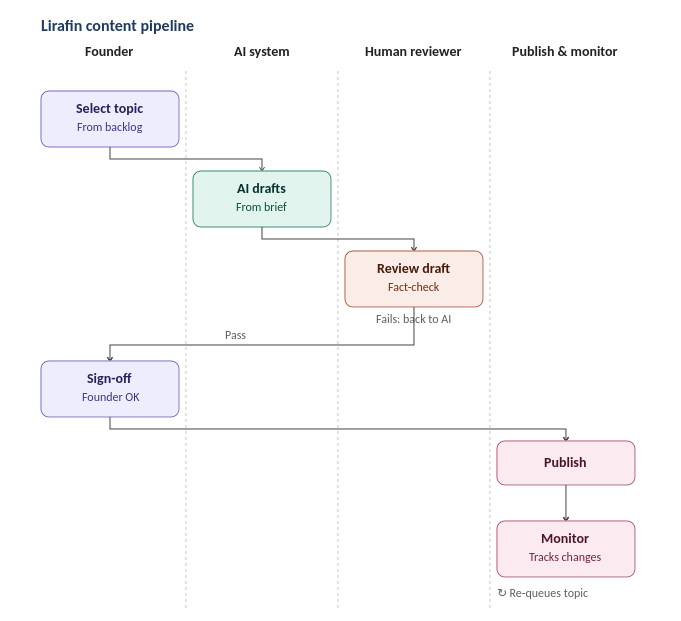
Two feedback loops keep the pipeline self-correcting rather than linear: a draft that fails validation returns to the AI system for revision, and a published article flagged during monitoring re-enters the backlog as a new topic brief.
Process Detail
Each of the six steps was specified with its owner, purpose, inputs, key activities, outputs, tools, and risks. The step that turned out to matter most:
| Field | Detail |
|---|---|
| Owner | Human reviewer / validator |
| Purpose | Ensure the draft is accurate, current, on-brand, and independent before it can proceed to founder sign-off, the pipeline's hard quality gate |
| Inputs | Draft article; AI's unverified-claims list; validation checklist |
| Key activities | Verify facts against primary sources; confirm no outdated regulatory or product information; check brand tone; confirm no undisclosed commercial bias |
| Outputs | Either an approved draft passed to sign-off, or the draft returned to the AI system with revision notes |
| Tools & techniques | Validation checklist; primary-source cross-referencing |
| Risks & notes | Reviewer capacity is the most likely bottleneck as AI output volume grows |
RACI Matrix
Once the process existed on paper, assigning Responsible, Accountable, Consulted, and Informed to each step made ownership impossible to leave vague:
| Pipeline step | Co-founders | AI system | Human reviewer | BA Consultant |
|---|---|---|---|---|
| Select topic | R / A | C (flags triggers) | I | C |
| Generate draft | I | R | I | I |
| Review & fact-check | I | I | R / A | I |
| Founder sign-off | R / A | I | C | I |
| Publish | A | I | I | I |
| Monitor for changes | A | I (surfaces alerts) | C | I |
What This Surfaced
The RACI matrix made an uncomfortable but useful fact explicit: the co-founders currently hold both Responsible and Accountable on two separate steps, topic selection and sign-off. That concentration is entirely reasonable at the current team size, but it's a scaling risk worth watching rather than an accident worth ignoring. It also raised an open governance question that had no obvious answer yet: should founder sign-off apply to every single article, or be tiered by content risk level, with a simple deals roundup treated differently from a tax-obligation piece?
Next: Risk & Requirements, what happened when I traced the pipeline's biggest flagged risk back to its actual root cause.