Stakeholder Analysis
The first phase of the Lirafin engagement: identifying who actually has a stake in the business, and designing engagement around the answer rather than treating "stakeholder management" as a single undifferentiated activity.
Method
Following BABOK v3's stakeholder analysis approach: identify every stakeholder, score each on influence (their power to affect the business's direction) and interest (how much the outcome matters to them), then design a tailored engagement strategy per quadrant rather than a one-size-fits-all update process.
At a two-person, AI-heavily-automated startup, "stakeholders" turned out to be a mix of people and process roles. The AI system itself is treated as a process dependency in the register below, not a true stakeholder, since it has no interests of its own, but it still needs to be tracked because of how much influence it has over outcomes.
Stakeholder Register
| Stakeholder | Interests | Concerns | Influence | Interest |
|---|---|---|---|---|
| Co-founder A | Site launched and growing; efficient AI workflows | Losing editorial control to automation; burnout from validation workload | High | High |
| Co-founder B | A structured, well-run business; disciplined delivery | Scope creep; process overhead slowing content output | High | High |
| BA Consultant | Clear mandate; adoption of BA artifacts and processes | Recommendations not implemented; limited access to founders' time | Medium | High |
| Expat readers | Guidance on Spanish systems in accessible language | Inaccurate or outdated info with real financial/legal consequences | Medium | High |
| Spanish citizen readers | Practical local money-saving content | Content feels expat-skewed or too basic | Medium | High |
| Human reviewers | Manageable workload; clear validation standards | Bottleneck if AI output volume outpaces review capacity | High | Medium |
| AI system (process dependency) | Clear prompts, source data, and validation criteria | Hallucinated or stale content reaching publication unchecked | High | N/A |
| Financial product providers | Potential referral relationships | None permitted to influence recommendations, by design | Low (by policy) | Medium |
| Regulators | Data protection and "information not advice" compliance | Site straying into regulated financial advice | High | Low |
| Future hires | Clear onboarding, defined processes | Joining a business with undocumented tribal knowledge | Low (growing) | Medium |
Influence / Interest Grid
Grouping the register into the standard four quadrants determines how much engagement effort each stakeholder actually needs:
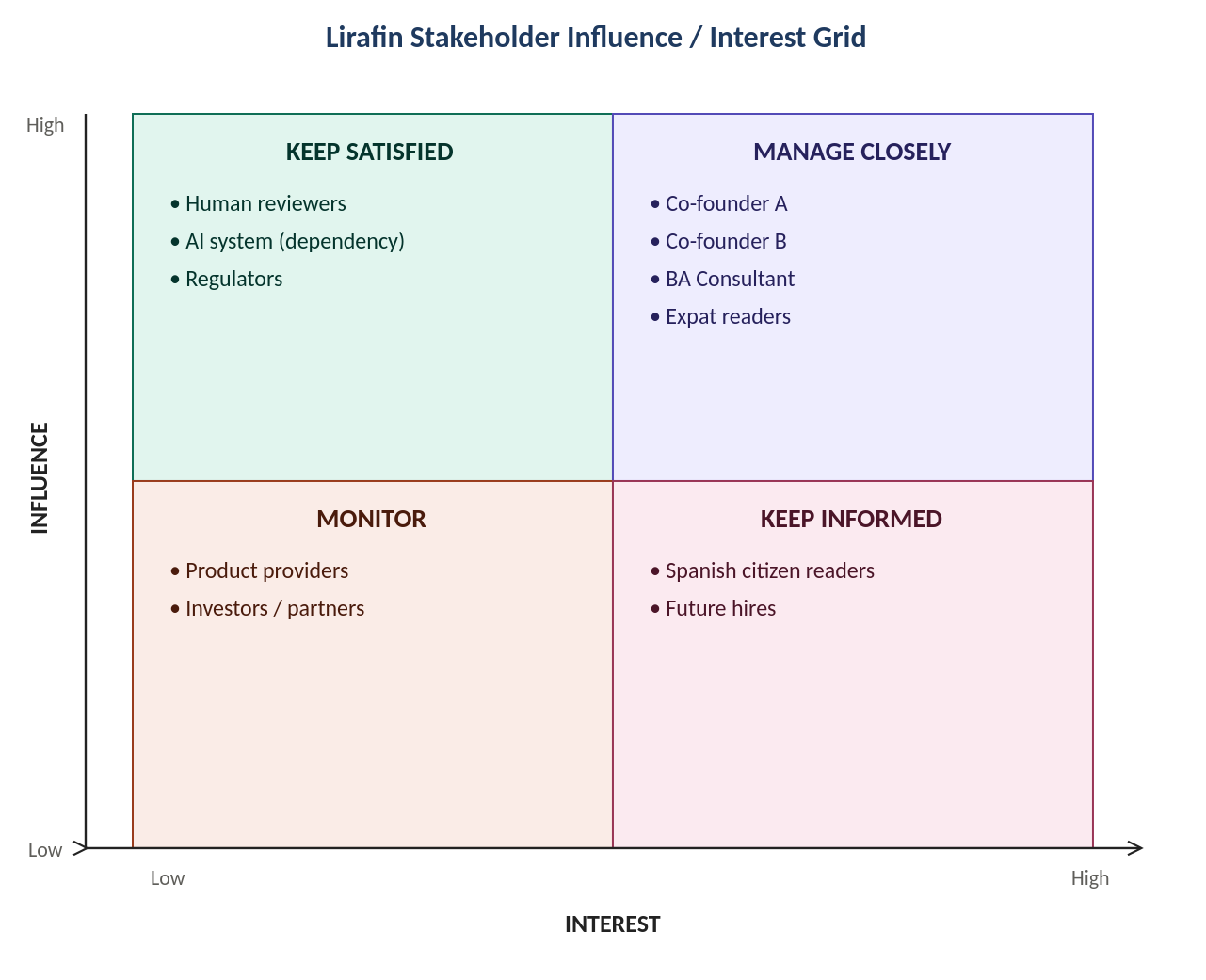
Manage Closely stakeholders get weekly check-ins and are treated as the primary requirements source. Keep Satisfied stakeholders need processes that meet their needs without constant involvement, this is where the human reviewer's workload and the AI system's prompt quality live. Keep Informed stakeholders get regular updates through the site itself or onboarding docs. Monitor stakeholders get light-touch tracking, revisited as the business scales.
What This Surfaced
Mapping the register onto the grid turned a vague sense of "who matters here" into something concrete, and it surfaced a governance gap that had been sitting unaddressed: the company's independence policy, which prevents financial product providers from influencing content or recommendations, existed only as an internal norm. It had never been written down as an explicit, public-facing rule. That's a small finding on paper and a real one in practice: an unwritten policy is much easier to accidentally compromise than a written one.
Next: Process Modeling, how the stakeholder map translated into an actual swimlane diagram and process specification.